Sancho Panza
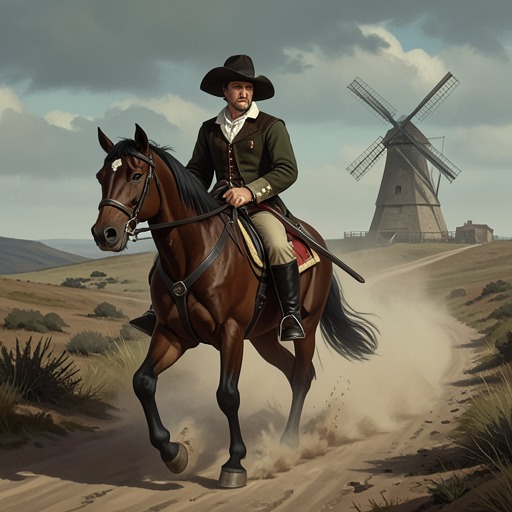
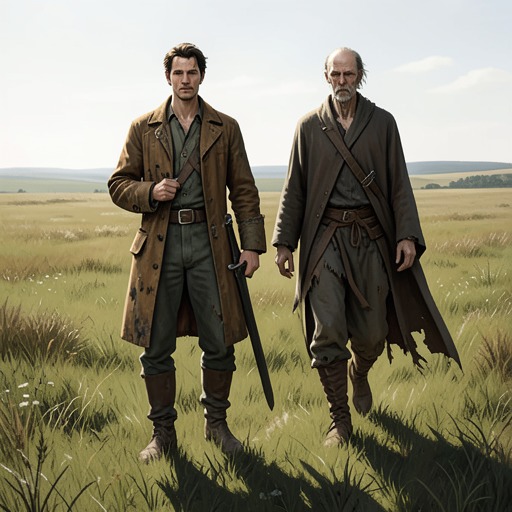
Don QuixoteSancho Panza is Don Quixote’s squire, a poor farm laborer whose hopes of becoming a governor bring him onto the road and whose practical intelligence gradually makes him more than a foil to his master. He measures adventures against food, family, recognizable facts, and the comfort of his donkey; yet he remains bound to Don Quixote by gratitude and affection. His appointment to govern Barataria turns an outlandish promise into a brief experiment in judgment and responsibility, and his return from it confirms that ambition has not erased his attachment to ordinary life.
Identity and Introduction
Sancho is not part of the story’s original conception of the knight’s equipment. The narrator reflects that the landlord’s chance observation—that knights seldom travel without squires—introduced the figure who would become indispensable. The comparison is deliberately comic: imagining Don Quixote without Sancho is like imagining a pair of scissors with one blade. The device that begins as a practical addition becomes the partnership around which the adventures repeatedly turn.
The preface presents Sancho as a concentrated embodiment of the comic traits assigned to squires in books of chivalry. A verse tribute likewise celebrates him through the humble signs of his station: his name, Dapple, and the provisions he carried in his saddlebags. This praise establishes the double register of the character. He belongs to a literary tradition of comic attendants, but his plainness, needs, and durable presence give him an independent weight in the narrative.
Sancho is introduced as a neighbor and farm laborer whom Don Quixote persuades with talk and promises. The narrator describes him as poor and not especially quick-witted; the decisive inducement is the prospect that an adventure might win an island and make him its governor. Sancho leaves his wife and children to serve as squire. His agreement is therefore neither an abstract devotion to chivalry nor simple wanderlust: it is a wager that service may change his household’s fortunes.
Hopes, Needs, and Practical Sense
The promised island immediately becomes Sancho’s measure of what the journey might yield. After one fight, he approaches Don Quixote, kneels, and asks for the government of the island supposedly won in the encounter. He insists that its size will not exceed his capacity. The persistence is part of the joke, but it also gives his service a concrete purpose: Sancho keeps track of promises even when Don Quixote understands the events that supposedly earn them through the language of knight-errantry.
His practical outlook is clearest when honor is offered in place of material advantage. Sancho says that bread and onions eaten alone in his own corner can taste better than a grand table where he must observe formalities, eat slowly, and forgo ordinary freedoms. He declines the honors Don Quixote proposes as rewards for service, asking instead for something useful. Yet the refusal does not end his ambition. Later, he imagines that if he receives a county he could lease its revenues to someone who would manage it, while he enjoys the income without the work. His hopes combine a desire for advancement with a distinctly unheroic preference for comfort.
That combination makes Sancho an alert judge of the difference between what is claimed and what can be seen. When he is tossed about at an inn, he rejects Don Quixote’s explanation that enchanted beings were responsible. He remembers hearing the names of the men involved, identifies Pedro Martinez, Tenorio Hernandez, and the innkeeper Juan Palomeque the Left-handed, and concludes that they were ordinary people. His explanation is bluntly grounded in experience: the injuries and the failure to leave the courtyard, he argues, cannot be settled by calling the assailants phantoms.
He applies the same skepticism when Don Quixote is carried home in a cage and others describe him as enchanted. Sancho points to the ordinary signs before him: his master eats, drinks, sleeps, and talks. He also recognizes the curate beneath a disguise and suspects that the new enchantment is a contrivance. His reasoning does not make him immune to marvels; in a later episode of apparent supernatural disturbance, he is swept rapidly from hand to hand across benches and left unable to understand what has happened, imagining that devils have carried him off. The contrast is characteristic: Sancho questions explanations that contradict familiar evidence, but the adventures can still overwhelm his ability to interpret what he sees.
The Squire and His Master
Sancho’s bond with Don Quixote is made from dependence, irritation, and chosen loyalty. At an inn where the Judge and others are entertained by Don Quixote’s extraordinary manner, Sancho is chiefly concerned that it is late and that he can finally rest. He settles on his donkey’s trappings. The modest detail places him beside his master’s public strangeness without making him share its priorities.
The household’s view of their partnership is less affectionate. When Don Quixote returns to the village, Sancho’s wife runs to meet him and first asks after the donkey; Sancho says the animal is better than his master. The niece and housekeeper, meanwhile, accuse him of deceiving Don Quixote and leading him from home. Sancho tries to force his way in to see his master, and the accusation exposes the cost others believe his companionship has imposed. His persistence also shows that the relationship is not merely a transaction in which he waits for an island.
Sancho does keep account of the promises and money involved. When Don Quixote tells him that he may go home if he is eager to see his wife and children, and offers to calculate what he has earned during their months away, Sancho answers by affirming the value of his master and the hope that further empires and islands remain ahead. On another occasion, moved by Master Pedro’s distress, he says that Don Quixote will acknowledge and make good any wrong he has done. He presents his master as a man who can be trusted to answer for his actions, even when Sancho himself cannot prevent the damage caused by their adventures.
Their mutual reliance is not always comfortable. Sancho admits that he bargained about wages partly because his wife pressed him to do so; he invokes his family’s standing and insists that he must also act as a man in his own household. Yet he rejects the idea that this bargaining makes him ungrateful. He recalls Don Quixote’s good words and deeds and agrees to remain with him. Later he describes himself as someone made better by keeping company with a good master, linking the time spent together to his own capacity and renewed hopes. His attachment grows alongside, not in place of, his wish for reward.
Barataria: Judgment and Responsibility
The promise of an island is fulfilled through a practical joke arranged by The Duke and The Duchess. After the staged adventure of the Distressed One, they decide to continue deceiving Don Quixote and Sancho, instructing their servants and vassals how to treat Sancho as governor. Barataria is not a separate island but a village of about a thousand inhabitants, one of the largest in The Duke’s lands. At its walled gates, officials and residents welcome Sancho; bells ring, he is taken to the principal church to give thanks, and burlesque ceremonies present him with the town’s keys and recognize him as perpetual governor. His clothes, beard, and squat figure astonish those who do not know the secret.
The appointment gives Sancho a chance to exercise the judgment he has acquired in conversation with Don Quixote. In one dispute, he notices that an old man gives a cane to his opponent while swearing that he has paid the money owed, then asks for the cane back after the oath. Sancho orders it broken; ten gold crowns are found inside. The people are astonished, and his deduction earns him a reputation for wisdom. Its method is not mysterious: he attends to a small inconsistency in the behavior of the person making the claim and tests the inference against the object itself.
In a harder case, Sancho is asked to decide whether a traveler should be allowed across a bridge when the arguments for condemning and absolving him are evenly balanced. He reasons that if truth would save the man, falsehood would condemn him, leaving the claims level. He therefore favors letting the traveler pass freely, explaining that doing good is more praiseworthy than doing evil. Sancho traces this judgment to advice Don Quixote gave him before he left to govern: when justice is doubtful, he should lean toward mercy. He cannot sign his name, but he offers to stand by the decision. The scene joins intellectual humility to an ability to apply counsel rather than merely repeat it.
Sancho’s administration also reaches beyond individual cases. He prohibits provision sellers in the state and allows wine to be imported from anywhere if its source is declared, so that its price can reflect its quality and reputation; anyone who waters wine or mislabels it is to forfeit his life. He reduces prices for shoes, boots, and stockings, especially shoes, which he considers excessively costly. The decrees show a governor attentive to ordinary consumers and commercial honesty, even within a government whose setting is deliberately comic.
The burdens of office quickly unsettle its attractions. Sancho says he knows little about governing islands and would rather live as a simple man than risk his soul as governor. When he eventually returns to The Duke and The Duchess, he says that he entered Barataria with nothing and leaves with nothing, having judged cases while perpetually hungry because Doctor Pedro Recio restricted his food. His account also recalls a nighttime attack on the town. The public title has brought anxiety and deprivation rather than the effortless revenues he once imagined.
Resignation, Dapple, and the Final Bond
Before taking office, Sancho’s reluctance is already visible in his refusal to undertake an airborne journey to help the bearded duennas. He fears what his supposed islanders would think if their governor were seen flying, and calculates that the journey to Kandy is so long that a tiring horse or offended giant could keep him away for years. His reasoning is comic, but it expresses a serious limit: the promised governorship matters to him, and he does not want to jeopardize it by being drawn into every fantastic demand.
His commitment to the enchantment of Dulcinea is likewise conditional and negotiated. Sancho agrees to give himself three thousand three hundred lashes to help disenchant her, but insists on choosing when to administer them, refuses a requirement that they draw blood, and asks that even ineffective fly-flaps count. He wants Merlin to keep the tally. When Don Quixote later urges him to perform the penance, Sancho protests that people ask him to spend his own pain and effort without payment. The squire who once trusted promises of future reward now bargains over the cost of fulfilling one himself.
After leaving Barataria, Sancho is sore and moves slowly, but he goes first to the stable and embraces Dapple, kissing the donkey on the forehead. He addresses him as companion, friend, and partner in toil and sorrow, and contrasts the easy days spent caring for him with the miseries and anxieties that came after climbing the towers of ambition and pride. He saddles Dapple before returning to The Duke and The Duchess. The gesture makes his departure from government more than a change of status: he chooses the familiar companionship and modest responsibilities that the promise of advancement had once seemed to outweigh.
Sancho’s loyalty is tested again after Don Quixote is defeated by the Knight of the White Moon and bound not to take up arms. Sancho is dejected and cannot tell whether the defeat is a dream or enchantment. Later, when asked to give an opinion in a doubtful matter, he points to his recent experience as governor and judge. Even after leaving office, its work remains part of his sense of what he can do. When Don Quixote’s testament settles their accounts, it releases Sancho from any claim over the money in his hands and grants him whatever balance remains. Don Quixote praises his simplicity and fidelity, acknowledging that he would give him a kingdom if he could.
Sancho answers the testament with tears and urges Don Quixote to live. He proposes that they take to the fields in shepherds’ clothing as they had planned, imagines that they may find Dulcinea disenchanted, and offers to let Don Quixote blame his defeat on a badly tightened girth. Since knights can be defeated one day and victorious the next, he refuses to treat the loss as final. His appeal brings their shared language of future adventures to the edge of the ending: Sancho still hopes, improvises, and tries to keep his master beside him. The squire who began by following the promise of an island ends by offering companionship when no reward can make that promise good.